
Explainers
Who Gets Counted, Who Gets Power?
How a Supreme Court fight over a census question became a debate about representation and democracy.
By Kerri Richards
November 3, 2026
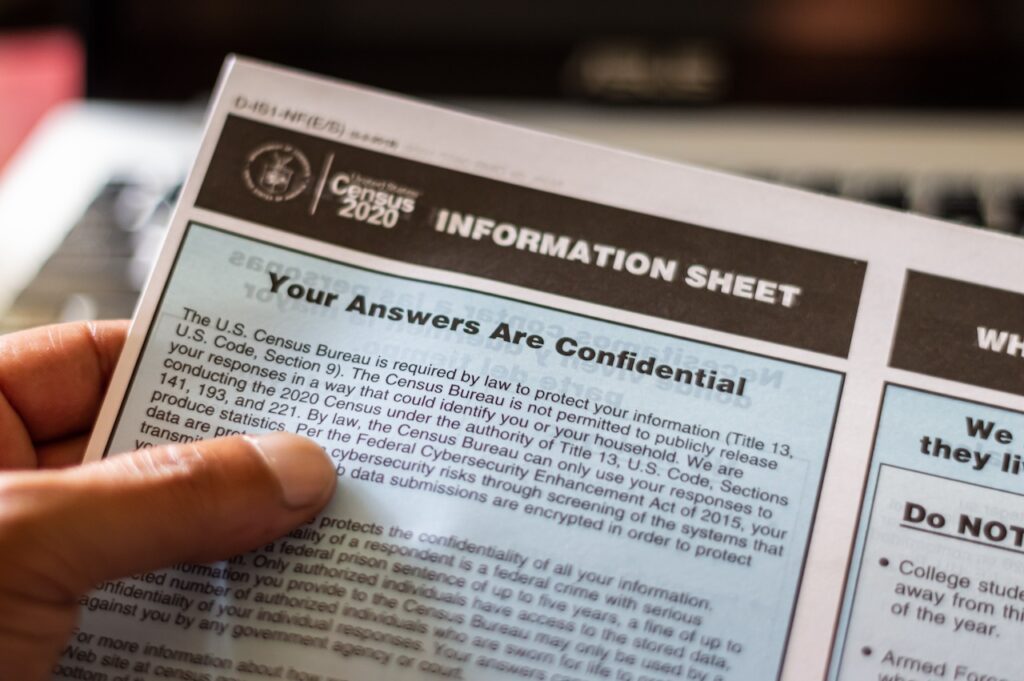
In 2019, the Supreme Court decided Department of Commerce v. New York, a case that, at first glance, seemed to be about a single question on a government form. In reality, it was about something much bigger: who gets counted in America, and who gets power because of it.
The Dispute That Reached the Supreme Court
The controversy began when the federal government announced plans to add a citizenship question to the 2020 census. Officials said the data would help enforce the Voting Rights Act, which protects minority voters from discrimination.
That explanation faced some healthy challenges. States, cities, and advocacy groups pushed back, arguing that the question would discourage participation, especially among immigrant communities. When people skip questions or respond briefly, it can lead to an undercount. Why does that matter? Because the census is not just a headcount. The census plays a crucial role in deciding how many seats each state has in Congress, how legislative districts are drawn, and how hundreds of billions of federal dollars are shared.
After a trial and appeal, the Court issued a careful but important ruling. It said the government can ask about citizenship. But it blocked this particular effort because the government’s explanation didn’t match the evidence. In plain terms, the government might have had the power to ask the question, but it hadn’t been honest about why it wanted to.
What the Court Really Said
At its core, this case is about limits on government power and the role courts play in enforcing those limits. The Court emphasized that federal agencies must follow basic rules of reasoned decision-making. When the government makes a major policy change, it must explain itself in a way that is consistent with the evidence, transparent to the public, and reviewable by courts. This standard is based on the idea that agency decisions should not be “arbitrary or capricious”.
Here, the Court found a disconnect between what the government said and what the record showed. Evidence revealed that officials had been interested in adding the citizenship question well before the Voting Rights Act justification was offered. In fact, the Department of Justice’s request appeared to have been solicited to support a decision already made.
That kind of mismatch matters. As the Court explained, judicial review is not a rubber stamp. If agencies could offer explanations after the fact, courts and the public would have no meaningful way to evaluate government action. The takeaway is straightforward yet powerful: the government must tell the truth about why it acts.
The Historical Claim and Its Limits
Supporters of the citizenship question often point to history. And it’s true, the census has, at times, gathered information about citizenship or birthplace. But the full story is more complex. Early censuses sometimes asked limited questions about citizenship, often directed at specific groups rather than the entire population. What the census has never done is ask a broad, nationwide citizenship question of everyone in the country in the way proposed for 2020.
The census has evolved over time. By the mid-20th century, officials concluded that collecting too much information on the main census form could interfere with accurately counting all individuals. As a result, they adapted their approach. Since 1960, the census has followed a two-track method: a short form is sent to all individuals to count the population, while detailed questions are collected through sample surveys such as the American Community Survey. This shift reflects a basic judgment: simplicity enhances accuracy.
The Real Debate Behind the Question
The modern debate isn’t really about history. It’s about competing priorities. Supporters argue that better citizenship data could improve enforcement of the Voting Rights Act, provide more accurate information for redistricting, and help policymakers better understand the population. In this view, the question is about data quality and governance.
Opponents highlight a more basic issue: participation. Studies indicate that including a citizenship question can affect how people respond, but not uniformly. Some groups, particularly households with noncitizens, are more likely to skip the census entirely, leave people off the form, or stop before finishing it.
Recent Census Bureau research shows that these effects are highly concentrated, especially among vulnerable groups. In other words, the question doesn’t just reduce responses; it risks misrepresenting who gets counted. And that’s the main concern. If the census becomes less accurate, everything built on it becomes less fair.
Why It Matters Beyond the Census
This debate may seem technical, but its consequences are very practical. It touches everyday questions about representation, funding, and fairness.

Representation in Congress
The census determines how many representatives each state gets. Even small undercounts can shift political power for a decade. That affects not only Congress but also the Electoral College. In a close election, shifts in apportionment could affect Electoral College dynamics. Communities that are undercounted don’t just lose numbers; they lose their voice.
Redistricting and Political Maps
Census data shapes the boundaries of voting districts. If certain populations are undercounted, districts won’t reflect the true population. Districts can be drawn in ways that weaken voting power, shift influence across regions, or lock in political advantages. In short, how we count people shapes the map of democracy.
Federal Funding
Census figures determine how federal funds are allocated for schools, healthcare, and infrastructure. If a community is undercounted, it may receive reduced funding and feel the effects for years. An undercount may mean fewer resources reach communities that need them most.
Trust in Government
Perhaps most importantly, this case reinforces a basic expectation that government decisions must be honest and accountable. The Court did not say the citizenship question was illegal in all circumstances. It said that the government must provide a real explanation, one that reflects what actually happened.
That principle extends far beyond the census. It applies to election rules, voting regulations, and administrative decisions across the government. When agencies must justify their actions honestly, it creates a safeguard against decisions that could quietly undermine democratic processes.
The Next Battle: Citizenship Data and Redistricting
Here’s where things get especially interesting. The citizenship question isn’t just about the census. It’s about what happens after the data is collected. If detailed citizenship data becomes available, it could be used to argue for redrawing districts based on citizen population rather than total population, the traditional metric.
That shift would be significant. Right now, districts are generally drawn based on total population; everyone counts. This method is deeply rooted in the nation’s tradition of representation. But if lawmakers push to base districts on citizens, it could reduce representation in areas with many immigrants, shift power toward regions with fewer noncitizens, and trigger renewed calls for mid-decade redistricting. That kind of redistricting is already controversial. Adding citizenship data could make it even more so. It’s not guaranteed, but it’s a very real possibility.
The Bigger Picture: Information, Power, and Representation
Department of Commerce v. New York is not just about a census question. It is about the connection between information and power. The census is the foundation of representation in the United States. It determines who is counted, how communities are recognized, and how resources are distributed. Small changes in how that data is collected can have enormous downstream effects. The Supreme Court’s decision is straightforward; the government has broad authority, but it must exercise that authority transparently and truthfully.
The Bottom Line
This case reminds us of something fundamental: Who gets counted determines who gets represented. The rules governing that process must be fair, open, and honest. That’s not just a legal principle. It’s a cornerstone of democratic legitimacy.